

GOLDEN VERSES - Step 28
Choosing Wisely

PART 8: RECOGNISING CAUSATION
The two steps in this part are about how we recognise causation and the consequences when we fail to recognise it when we meet it. People speak of seeing their lives pass before their eyes at the point of death, when everything is rapidly wound up, but we have many points before that time when we can make its acquaintance and begin to make better headway with our lives.
We all recognize those individuals who always seem to be immersed in an endlessly successive tangle of misfortunes, for there seems to be at least one such person in most people’s social circle or workplace. This is the person who, no matter how many times they have their lost keys recut, their work-passes replaced, or important documents reprinted, find they have lost them by the next week. Or else they are like the White Knight, who has his mind fixed on some other thing while simultaneously being unable to live ordinary, everyday life.
“Alice thought she had never seen such a strange-looking soldier in all her life. He was dressed in tin armour, which seemed to fit him very badly, and he had a queer-shaped little deal box fastened across his shoulder, upside-down, and with the lid hanging open. Alice looked at it with great curiosity.
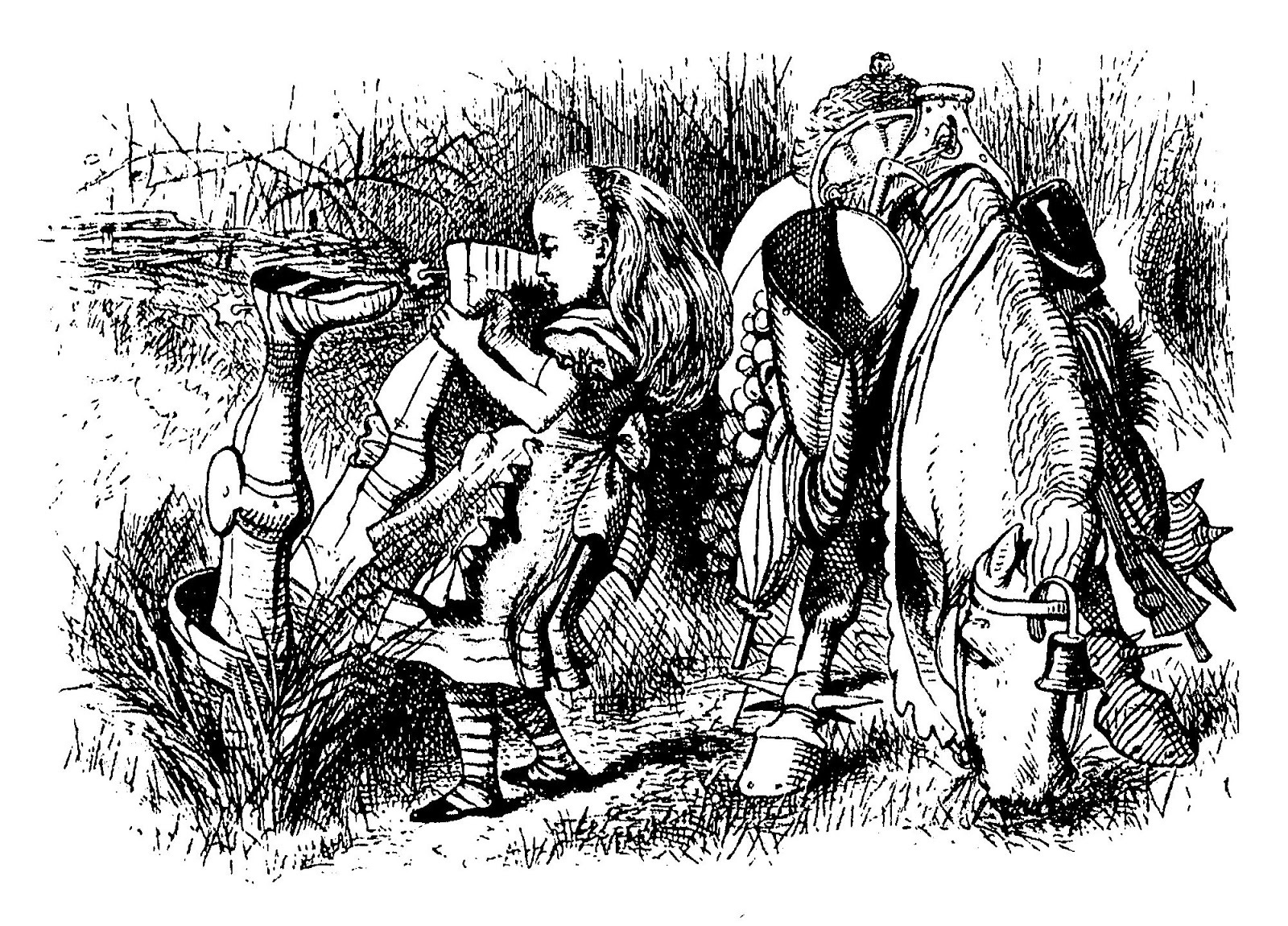
.‘I see you’re admiring my little box.’ the Knight said in a friendly tone. ‘It’s my own invention—to keep clothes and sandwiches in. You see I carry it upside-down, so that the rain can’t get in.’
‘But the things can get out,’ Alice gently remarked. ‘Do you know the lid’s open?’
‘I didn’t know it,’ the Knight said, a shade of vexation passing over his face. ‘Then all the things must have fallen out! And the box is no use without them.’ He unfastened it as he spoke, and was just going to throw it into the bushes, when a sudden thought seemed to strike him, and he hung it carefully on a tree. ‘Can you guess why I did that?’ he said to Alice.
Alice shook her head.
‘In hopes some bees may make a nest in it—then I should get the honey.’
‘But you’ve got a bee-hive—or something like one—fastened to the saddle,’ said Alice.
‘Yes, it’s a very good bee-hive,’ the Knight said in a discontented tone, ‘one of the best kind. But not a single bee has come near it yet. And the other thing is a mouse-trap. I suppose the mice keep the bees out—or the bees keep the mice out, I don’t know which.’
‘I was wondering what the mouse-trap was for,’ said Alice. ‘It isn’t very likely there would be any mice on the horse’s back.’” (Lewis Carroll, Through the Looking Glass Chapter 8)
And at the other end of misfortune, there are those whose lives and relationships seem to have come straight out of a Greek tragedy, so dramatic and disorderly they are. Any attempt to aid them seems somehow to be drawn into the fray, only making it worse
All these conditions, however, are but symptoms of a far greater malaise that afflicts us all, and none of us can either rejoice in our better fortune, nor can we despise those who seem worse off than ourselves, because we are all similarly entangled to some degree. Let’s step into this part and see how we may extricate ourselves.
STEP 28 CHOOSING WISELY
§ You will also know that humans bring on themselves
Their own misfortunes of their own free choice.
How unhappy are they who neither see nor understand
That their good stands near to them!
Few understand how to free themselves from their miseries.
Such is the fate that blinds their senses
Like cylinders that roll aimlessly to and fro,
Always suffering endless misfortunes. §
Verses 55-59
BRINGING IT ON OURSELVES?
Recognizing the causation of our actions and connecting them to the effect they might have, is a hard-won skill for human beings. It is something we try to model for our children, to help them learn from life in the kindest and most efficient way. When our son was small, a fair came to the local park; for days running up to it, he was very excited; once we arrived there, he wanted to play all the games, and try some of the rides in the fairground. We walked around the whole array together to see it all, so he could make a better informed choice, but he was desperate to try some of the games. Knowing what would be the outcome, we gave him five pounds in small change, so he could pay for what he wanted to do. We made it clear that this was all the money he would be given, and that whatever he chose to spend it on, it was his choice.
Within ten minutes he had, of course, spent all the money. He had bought a small toy with most of it, and had outlayed the rest of it on the (probably rigged) games on the stalls. On top of this experience, the trashy toy promptly broke after a few minutes use, so the afternoon ended unhappily. Our son had made his choices, and that was that. We also felt awful, but knew that, at least, he had learned a little more about cause and effect, and would weigh up his choices better next time. Within a few years, he had indeed learned how to discern things in a more mature way, and has taken much sharper decisions since.
The beginning of the verses this step, about misfortunes being of our own free choice, may sound very like the New Age aphorism ‘you create your own reality,’ but this not precisely what is being said here. In truth, we lack the greater perspective to see the whole of even one life, let alone a series of them. Decisions that were made in other times and places may be playing out in our world in ways that will involve us, whereas those choices we ourselves have made may have implications in times and places unknown to us.
Whichever is the case with us, we have to decide to abide by the divine law which orders the universe: anything else will end with us following our own instincts and our desires, and we will become like ‘the dog chained to a chariot,’ which Chrysippus mentions:
‘if it wants to follow the chariot, it is both pulled and it follows the pull, doing out of free will what necessity or fate demands. However, if it doesn’t want to follow, it will be forced to do so in every way. The same is perhaps the case with humans. Even if they don’t want to follow, they will be forced in every way to enter into their fated course.’
That divine law is well outlined by the Oath that we looked at in step 2 which orders the entire cosmos, and supported by the rest of the Golden Verses which models for us the method that help us make better choices. Most of our decisions could be taken by referring to the divine perspective, if only we turn in that direction first, rather than towards our reactivity and desires. The all-embracing harmony of the Oath, and our ability to listen to it is really a kind of primaeval obedience to that harmony.
Our very inability to think sacredly first is precisely why the text speaks of us freely of choosing our troubles. We become wretched and sorry through our own choices, for at one time we are still able to remain in the world by not paying heed to the good thatis close by, where virtue and truth are really the goods, and people’s failure to see that they are close by, stems from them not rousing themselves to discover the morally beautiful, and their failure to heed means that they do not listen to the teachings of others.
The recovery of knowledge is in fact twofold: either through learning, as through listening, or through discovery as through seeing. That “we have really chosen our trouble” is said of those who are unwilling to learn from others, or to make their own discoveries, since they are bereft of an inner awareness of what is good and therefore completely useless, for “whoever does not themselves understand, nor take it to heart and speaks, that is a useless person” as Hesiod said.
But those who make it their task to learn and discover the good from people who understand the deliverance from evil, and by fleeing those miseries changed their abode for a better estate, but such people are few. Most give way, following their attachment to a mortal passion which can mentally damage them; for by following this inclination they suffer evil by their own fault; because they want to flee from the divine and separate themselves from fellowship with the divine, leaving the pure radiance in which they were happy when they remained in their better estate.’
(GV. XXIV, 10-12)
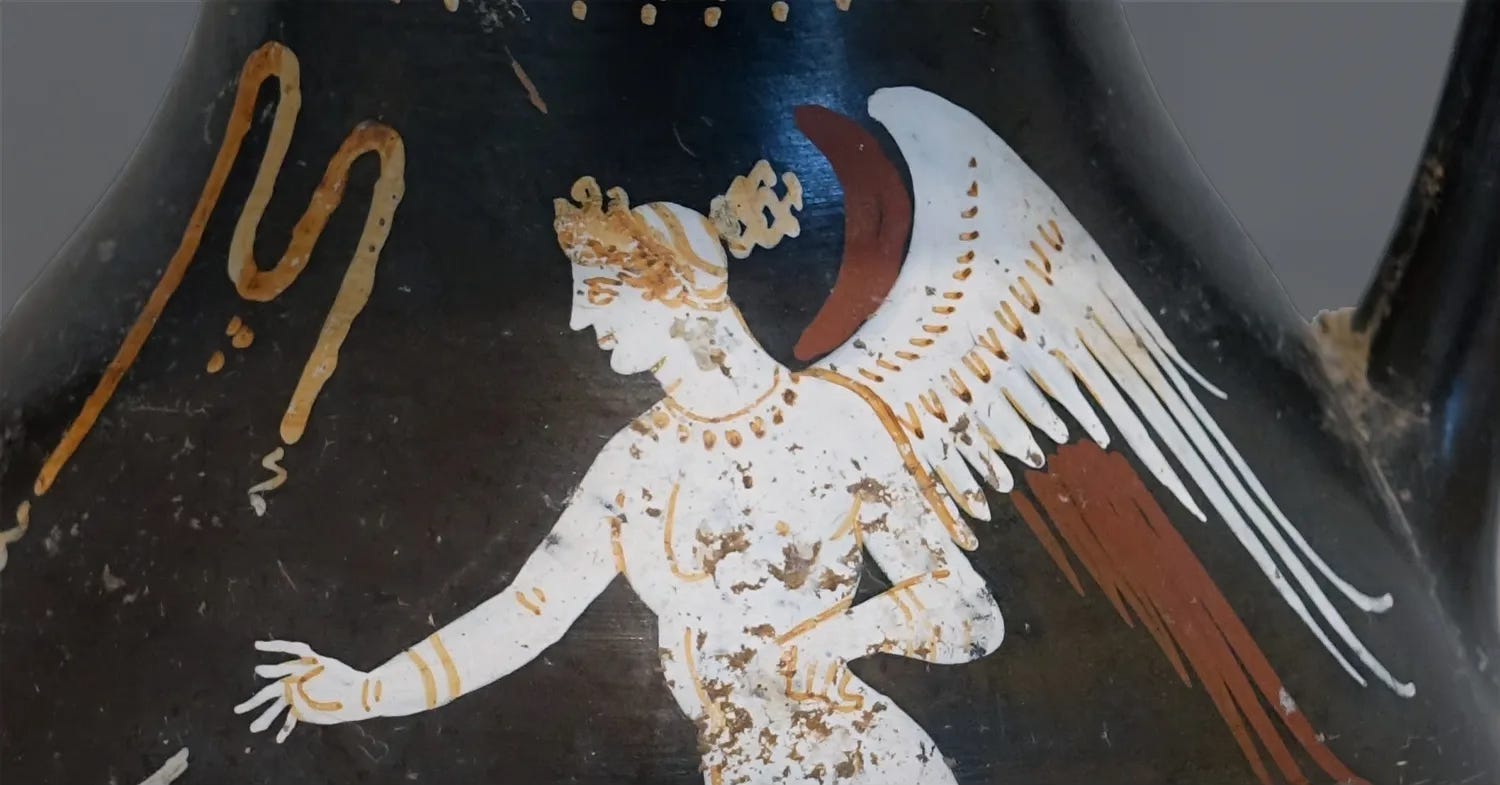
The ‘better estate’ that the miserable once had in this passage is, of course, the communion that they once enjoyed with the divine friendship. The Neoplatonic myth speaks of this state as our once possessing wings – a metaphor of our divine closeness and harmony with all things, such as Pythagoras and others strove to daily live.
THE GOOD THAT STANDS NEAR US
What is the good that stands near us? Where do we find it?
In Plato’s Laws 904, the Athenian Stranger discusses the how the arranging God uses the nature soul to unfold the great cosmos: ‘and besides, since that which is good in the soul is always naturally disposed to assist, but that which is evil in it to injure. Our king, perceiving all these things, devised in what manner each of the parts should be situated, so that virtue might vanquish in the universe, but vice be subdued, in the most eminent degree, and in the best and most facile manner. He devised, therefore, how each particular should be generated with reference to the universe, what seat it should reside in, and what places it should be allotted: but he left to our will the causes of this or that generation. For where the desire of any soul is, and such as is its condition, there each of us nearly resides, and such for the most part each of us subsists.”
What is allotted to us stands close to us, but the trick is to work out what we are to do with what we have been given. In the Republic 617, where Socrates relates the Myth of Er, he reveals the inviolable right of the soul to choose: ‘He who draws the first (lot), let him first make choice of a life, to which he must of necessity adhere: Virtue is independent, which everyone shall partake of, more or less, according as he honours or dishonours her: the cause is in him who makes the choice, and God is blameless.”
So, virtue gives us independence! But also, love and encouragement make all the difference in this work. We need that loving help, and cannot cut ourselves off from it. This is something we see clearly in Plotinus who leads us into a different way of understanding, as Pierre Hadot has argued: ‘it is neither the universal Intellect nor the archetypal Forms of the Cosmos that kindle our love, rather it is what animates the intelligible world of beauty and being, which is nothing less than the grace which is bestowed upon it by the One: “Each (form) is what it is by itself, but it becomes desirable when the Good colours it, giving a kind of grace (charitas) to them and passionate love (erotas) to the desirers (ephiena).’” (Plotinus, Enneads 6.7.22, 5-7)
The world of the philosopher can sometimes come over as joyless and severe, but the true mainspring is the leading of the soul. Rather than being pulled behind the chariot willy-nilly, or by saturating ourselves in austerity, which can cause the soul to become bored, our soul longs to leap up and become beautiful. Plotinus also reminds us that we are work in process:
‘Go back into yourself and look; and if you do not yet see yourself beautiful, then, just as someone making a statue which has to be beautiful cuts away here and polishes there and makes one part smooth and clears another till Lee has given his statue a beautiful face, so you two must cut away excess and straighten the crooked and clear the dark and make it bright, and never stop working on your statue till the divine glory of virtue shines out on you until you see “self-mastery and thrown upon its holy seat.”’
(Plotinus Enneads,1.6.9.7-16)
Freeing ourselves of misery, we have to call back our minds to the task. Hierocles makes it plainer:
‘The fate that “harms the mind” may explain our separation from the divine. For it is impossible not to become mindless if one is bereft of the divine, or not to become bereft of the divine if we fall into mindlessness. The mindless person is necessarily godless as well, and the godless person mindless. Since they do not rouse themselves to the love of the beautiful, they suffer endless troubles, borne along like cylinders, by their debasing actions, not knowing how to help themselves, because they approach all fortunes without any instruction. To put it simply: there is nothing in life which does not become a source of evil for mindless people from every side. They are driven into dire straits by their freely-chosen wickedness, by their failure to look towards the divine light, and by their unwillingness to perceive what the true good lies; instead they have sunk into an attachment for mortal passions and borne along by life as by a flood.’ (GV, XXIV 13-14, 25-26)
What about those cylinders? What are they about?
TEN GREEN BOTTLES

The passage about cylinders rolling aimlessly to and fro reminds me of the steadily decreasing verses of Ten Green Bottles Hanging on the Wall and the many options and opportunities that are given to us in life, that can become diminished through carelessness, inattention, and fate. People who live without a pronounced sense of the universal essence or any support, often live with a sense of the universe personally zapping them. Like Private Frazer in the classic BBC comedy series, Dad’s Army, they may well utter the words, ‘We’re all doomed!’ For my generation, this catch-phrase became the epitomy of being zapped by the universe.
The metaphor of cylinders that roll to and fro seems rather odd and may not be immediately understandable to us, but it is found first in the arguments of the Stoic philosopher, Chrysippus (280-207 BCE) who looked at the compatibility of fate with human will. He reckoned that if human beings ‘do not do evils voluntarily but are dragged by fate’, then it is unjust to punish criminals.’ It is Chrysippus who uses the famous illustration of the cylinder and cone, which cannot start moving without being pushed. However, when they are pushed, the cylinder rolls and the cone spins by their own nature. He is showing us that it is the cylinder or the cone’s innate nature to behave in this way: they cannot help it because of their inherent shape. (You can read more about this experiment here: Daniolo Suster, Chrysippus, Cylinder, Causation and Compatibilism, https://philpapers.org/archive/SUSCCC.pdf.)
Earlier still, in Plato’s Timaeus, we hear how when bodies were given limbs as a mode of locomotion, they were also given heads so that bodies should not roll around like cylinders. (Plato, Tim 44D) At one level, this seems utterly ridiculous to us who understand the laws of evolution, but this obscure and risible explanation is merely pointing to something else: the implication about human beings and their behaviour is that we have our own legs to remove ourselves from unwise actions, and we also have our heads or reason to avoid becoming the prey to our worser natures.
‘As long as we are rolled about things beneath, it will appear to us to be incredible that divinity knows all things….(p.24. Proclus On Providence and Fate.) Further on, Proclus speaks of, ‘Our sorrows germinate in us as the voluntary progeny of the particular life which we lead.’ Proclus, ibid, 35, 25. In other words, the offspring and result of our unheeding lifestyle is likely to be misery.
Epictetus gives us the last word:
“I have just one thing to say to you, that whoever is ignorant of who they are and for what they were born, and in what kind of world they find themselves, and with what people they are sharing their life with; whoever is ignorant of which things are good and bad, which are honourable or harmful, and who is incapable of following an argument or a proof, and who doesn’t know what is true or false, and cannot distinguish between them: such a person will employ neither their desires, nor their aversions, nor their motives or designs, nor their assent and dissent in harmony with nature, but being virtually deaf and blind, they’ll go around thinking that they are somebody, when in truth they are nobody at all. Do you suppose that there is anything new in this? Surely it’s the case that ever since the human race came into being, it is from this ignorance that all our errors and misfortunes have arisen?’ (ED 2:24, 19-20)
§ CONSIDER §
*** The pre-Socratic philosopher Hieroclitus left us only fragments of his work, but one quotation from it is given in the Golden Verses: ‘Immortals are mortal; mortals are immortal, living the other’s death and dying the other’s life.’ Iamblichus also riffs on this in his Protreptic, ‘Who knows if to live is to be dead, and to be dead is to live?’ Take these two related quotations into your meditation: how are mortal and immortal in relationship? What do you learn from your contemplation? Now, apply that understanding to yourself.
*** We may not know the full story, or discern the allotment of our fate, and its working out. Here, Marcus Aurelius invites us to consider a way through all difficulties: ‘Welcome everything which happens, even if it seems harsh, because it contributes to the health of the universe and the welfare and well-being of the divine. Divine would not have brought this on person unless it had been advantageous to the whole.’ (Marcus Aurelius Meditations 4: 23.) Without getting wound up in ideas about ‘an ultimate plan’ of the cosmos, which is gainfully missing from Neoplatonic and Pythagorean thought, spend just one day this week living with this invitation..
*** Whether you have come to this study in your youth or your age, be heartened by this part of the Myth of Er: ‘Because virtue is free and not subject to Necessity, even the person who draws the last lot can choose wisely, live a disciplined life, and thus end up with a respectable life rather than an evil one. The first to choose should not be careless and the last should not be discouraged.’ Make this your prayer, clothing yourself with the garment of your virtuous practice; whatever befalls, it is your choice to live in that cloak.
MEDITATION: FROM THE MEADOWS OF ATÉ TO THE PLAINS OF TRUTH
Greek myth, from Hesiod onwards, speaks of Até as the personification of delusion, blind folly, and reckless impulse. But Até (delusion) is also closely followed by Litae (prayers.) This is what Homer has to say about them both:
“The very immortals can be moved; their virtue and honour and strength are greater than ours are, and yet with sacrifices and offerings for endearment, with libations and with savour men turn back even the immortals in supplication, when any man does wrong and transgresses. For there are also the Litai (Litae, Prayers), the daughters of great Zeus, and they are lame of their feet, and wrinkled, and cast their eyes sidelong, who toil on their way left far behind by the spirit of Ruin (Ate): but she, Ate (Ruin), is strong and sound on her feet, and therefore far outruns all Litai (Prayers), and wins into every country to force men astray; and the Litai (Prayers) follow as healers after her. If a man venerates these daughters of Zeus as they draw near, such a man they bring great advantage, and hear his entreaty; but if a man shall deny them, and stubbornly with a harsh word refuse, they go to Zeus, son of Kronos, in supplication that Ate (Ruin) may over take this man, that he be hurt, and punished.” (Homer, Iliad 9. 498 ff)

The Golden Verses also speak of the meadows of Até as the place where we dip into our mortal nature and are led by rash action. This kind of wandering is disastrous, but our immortal nature, whose foothold is our soul, tries to return us to the meadow of truth.The myth by which our immortal nature is betrayed is told in Plato’s Phaedrus, where we lose our wings and become detached from our kindred star. Hierocles unites these two myths in these passages:
‘Whoever shuns the meadows of Ate is led by that good desire into the meadow of Truth. But should they ever forsake it, their wings will flag and fail from them, and down they drop headfirst into an earthly body.’ (GV, XXIV, 3) Becoming bereft of the blessed life, we may agree with Plato that: ‘we wander bewildered, helpless of relief, in the dark plains of injury and grief.’ But we each strive to make the ascent and to regain our wings, and begin to see how we can ‘subdue the troublesome and irrational mass of earth, water, air and fire that has come to attach itself to us, and arrive at the form of our first and best estate,’ and become raised, ‘to our kindred star’ having become healthy and whole once again.’ (GV XXIV 4)
‘Evils cannot be abolished…. Nor can they exist among the gods… but of necessity they hover about this earth and mortal nature.’ For beings who are involved in birth and destruction are in some way especially attended by the possibility of being disposed contrary to their nature: this is exactly the origin of evils. How we must avoid these is taught by Plato, ‘to flee means to become like god as far as possible for humans, ‘ and to become like god is to become just and holy, with the addition of wisdom.. The person wanting to escape evils must first turn away from their mortal nature, for it is not possible that those who are kneaded together with evil should not, of necessity, be infected with its attendant evils…. No, the only way to be delivered from all these evils is to return to the divine; this return only those who have the eyes and ears of their soul always open to the recovery of those things that are truly good can enjoy. These persons, by the faculty that they have of raising themselves up to the divine, have healed the evil that is inherent in our earthly nature. (GV. XXIV 6,)
Well done for coming round the corner of Part 8! Hierocles gives us a big gear change from this step onwards. There will be one more Golden Verses step before Midwinter now, with posts resuming in the New Year. The last six steps will conclude in March, when something entirely new replaces it: more on that anon-ly!
I’m hoping that those of you who’ve followed the Golden Verses from the beginning will be able to send in a short realisation or experience during this time to put into the last section.
It shouldn't be, but nevertheless is, a continuing source of wonder and fascination to me that what I read in your words, Caitlin, and in those of the ancient philosophers you quote, is the same insight and wisdom which has been guiding me inwardly for quite some time now. Of course, I have read books too - but not these particular sources - and I have been exposed to teachings exteriorly as well as interiorly, but the sense of there being a kind of common fountainhead from which it all streams is profound. Ancient, ageless wisdom, perennial philosophy, supremely beautiful, leading us from darkness to light, from the unreal to the real, from death to immortality. (From one who knows from bitter and painful experience the loss of 'wings' - but with increasing joy at their recovery.) Blessings as always on your work 💚
Hello,
I have been following the verses from the beginning and am happy to share a bit of my experience. I resonated with the verses right away and the way you flesh them out has helped them come to life. I feel these teachings from the inside, like an invisible framework being built within me. I felt the need to print them, highlight the parts that spoke to my soul and hold the writings in my hands. I knew I would need to be reading them again. It would be impossible to share all the realizations - these have been life changing for me, bringing dignity and joy. One practice that has stuck with me is to go back over the day at the end of the night to help build memory and capacity for knowing what worked and what didn't work. This practical skill is a pleasure to my brain. I am grateful.