HONOURING THE MYTHIC ARCHETYPES
How We Should Step Into the Mythic Footprint?

STEPPING WARILY
Everywhere today, people are using and invoking myth, its stories and archetypes without a great deal of consideration. We forget at our peril that the archae in ‘archetype’, tells us that myths live within a sacred context, so that when we take a mythic archetype as something generically psychological and not actual, or without considering the soil in which it grows, we lose context and, worse, we can begin to misapply them to ourselves in disastrous ways.
Tuning to the divinity or archetype is usually done as part of a spiritual initiation, handled by people who were themselves initiates. The myth of a people or a divinity was specific to a place or culture and, while we can observe the same ‘call sign’ of a divinity in other places, much as the Romans did when they invaded new territory, equating their gods with the ones of the land they conquered, the myth has its own belongings. This is why context and lineage matter, and why things can begin to go wrong when archetypes are severed from their myths.
This kind of fragmented mindset is rather like the one that insists that the main reason we should save the Amazon rainforest is largely because it might have precious medicines that will help humanity, rather than having concern that the people, plants and animals who live there might also need us to honour their environment first. We make use of archetypes rather than approaching them with respect as primary powers with their own being.
Basing our approach to myth by its utility rather than its sacred teaching is fraught with danger. When we step into the older footprint of myth, we have to honour sacred connections and not cherry-pick archetypes at our leisure.
We may ask first, what is myth? As Sallustius said, ‘Myth is something that is never happened and is happening all the time.’ (Concerning the Gods and the World, 4) The truth-bearing metaphor of myth gives us the story that can be a pathway into deeper understanding.
If we approach myths and archetypes as a secular modern person, without any sense of their truth and being, without taking regard of its sacrality, we really it approach disrespectfully.
FINDING OUR MYTHIC SOUL SHEPHERD
As young adults we usually identify the myths and stories that call out to us quite early on. These will be the stories that move you and touch something vital in your soul. But the way of it is perhaps more extraordinary than we image.
So how does the myth or its archetypes reach out to us and call us? The ancients wrote about this in a clear ways that can be helpful to us: Plato states that in the Age of Gold, ‘Over every herd of living creatures throughout all their tribes was set a heavenly daimon to be its shepherd....’ The Statesman. In our own culture, we may translate the daimon by considering the tradition of the guardian angel or the spiritual mentor who mediates the greater divinity as a soul-shepherd. Just as Arthur is raised by Myrddin, so we are all raised and guided by our daimons.
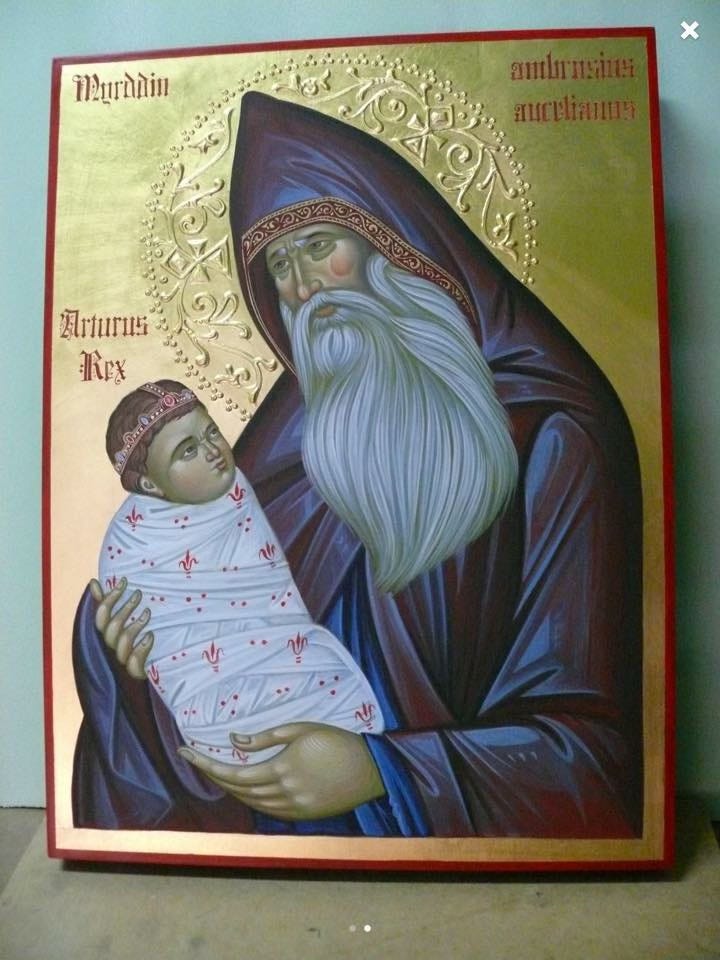
We are all marinated in the school of that daimon, who is the shepherd of our soul - who can bring to our attention the divinity who is a greater influence, and mediate that influence in a way more suited to our condition.
In the Hermetic text, Kore Kosmou, from the Hellenic Egyptian city of Alexandria speaks further about this. Here the goddess, Isis, speaks with her son, Horus, about how souls come into bodies:
‘When then, oh my son Horus, the ministering angels and genii appointed are war-like, the soul in their charge takes that character forgetting its own, or rather laying it aside until some future change of condition. If the guardian angels are of a gentle order, then the soul follows its path in peace; if they are friends of judgement, the soul loves to judge; if they are musicians, then the soul sings; if they love truth, the soul is a philosopher. Thus, the souls necessarily follow the teachings of their guardian; falling into human bodies they forgo the proper estate, and while exiled from it they approximate to those intelligences by whom they have been embodied.’ (Kore Kosmou, part 2, trans. Anne Kingslake.)
We come into the purlieu of a myth and its divinities by this means, having certain predispositions, being responsive to certain prompts, songs, stories and metaphors, which, hopefully, we come closest to the source with respect and wonder. But we cannot know the whole landscape of a myth just like that - it is too big for us to see it at one view. Just because you have read a retelling of a myth in a book, doesn’t mean to say that you understand its entire stratification.
The 5th century Neoplatonist and Bishop, Synesius, who knew both the Pagan and Christian mysteries personally, speaks of this. He says of the gods, ‘We may safely venture to say so much about, say, Osiris; but beyond this, let only words of good augury be spoken, says one who cautiously employs sacred language. As to those things which lie far away (ie.sacred matters), it would be part of a foolhardy mind and tongue to reveal them, and let them be kept in holy silence untouched by written words, lest one should cast an eye on anything not permitted, for he who reveals, as he who sees, such things incurs the wrath of the divine nature.’
Then he speaks about certain of the Mystery religions which come with their own small-print: ‘ the legends of Boeotia tell us that those who intrude and spy upon the secret rites of Dionysus are torn to pieces. Ignorance in the case of initiations is sanctity. On this account the night is entrusted with the mysteries, and caverns that may not be trodden are hollowed out for this reason. Moments and places are chosen that know how to conceal the inspired celebration of the mysteries.’
(Synesius On Providence. https://www.livius.org/sources/content/synesius/synesius-on-providence/synesius-on-providence-2.5/)
Reticence about the Mysteries was the ancient norm: but, in our age, it is more about blabbing everything out on social media. How can we be guided? Again, Synesius advises us to pray for the best guides to lead us to the deep Mysteries of the myth that draws us:
‘Send me a companion,
the sacred messenger of holy power,
the messenger of divine, inspired prayer,
the friendly giver, keeper of the soul,
keeper of life, guardian of prayers and works.
May this companion preserve my body free from sickness,
preserve my spirit free from shame.’
HOW DO WE APPROACH THE GODS?
An archetype or dignity is calling, what do you do? As a human being, consider what the nature of the contract between you is made up of. Ask,. ’What do I fulfil for my divinity or spirit? What do they fulfil for me? What pleases them? How do I need to reposition myself to be of service?’ These questions might save you a lot of trouble.
We have all been at gatherings where hubris and a lack of respect lead the way, where certain people have made their own connections with archetypes, divinities and myths. But instead of acknowledging that they are moved by these stories, some will go straight to self-identification with the divinity, insisting that they ARE the divinity. The streets of Glastonbury are full of King Arthurs, and the halls of esoteric teachings with a host of red-haired Mary Magdalenes and the like. Here, the overlay of the mythic archetype has utterly swamped the human being.
While it is indeed an ancient temple tradition for mediators, priest, priestesses, and oracles to briefly embody, for the purposes of ritual, certain archetypes and divinities, they only do so within the ritual space: they do not live their daily lives AS a divinity, but put off the cloak and become themselves again. In dedicated service, this is healthy. But what happens in an unreconstructed or untrained person when identification replaces healthy relationship, and the simple practices that create respectful distance, and loving service?
We speak of archetypes freely, but these are BIG, sacred beings who are worthy of respect. If we serve them as human devotees, we learn the boundaries and the agreements of that relationship. It is easy to become swamped by a divinity or spirit, to assume that it really IS you. But this is delusion, and will lead us down a road we really do not wish to travel, where the fullest range of misfortune can befall us - this is the sad end of all hubris, where we take divine powers to be our own. We have all seen the friend who has taken on the archetype and now begs you to address them as the archetype they are now identifying with: they become inhuman, uncaring of ordinary responsibility and loving relationships, and may end up in a secure mental unit. When world leaders do this, it creates misery for all citizens of their country. Let us consider the effect upon the world when we take on the cloak of an archetype or divinity!
Respect and service are the key words for this work. It is through sacred contracts, offerings, and good manners that keep mythic and archetypal work grounded, and mutually respectful.
We forget the small-print on sacred relationships at our peril!
This interview between myself and Liane of Be Mythical, looks at the landscape of this issue in more detail.
Being human and working between the worlds with archetypes and divinities can be confusing, which is why good tuition and guidance is helpful. Our Walkers Between the Worlds shamanic training programme is for all who wish to follow the lore of the Sister Islands of Britain and Ireland.. Our courses for next year can be found here. https://www.hallowquest.org.uk/resources/allcoursesjuly25.pdf