

WILLIAM BLAKE THROUGH THE HEARTS AND EYES OF LOVE
A Review of Philip Hoare's WIlliam Blake and the Sea Monsters of Love

I will come clean from the outset and say that I have been a Blake aficionado from a very early age. He is one of my hero-poets whom I hold in very high esteem indeed, as poet, artist, and visionary.
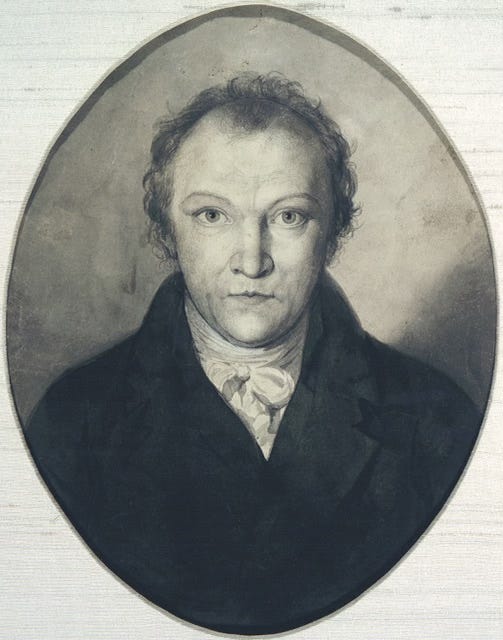
I’ve just finished this extraordinary book by Philip Hore after a two week reading before bed each night. It would defy even a good library cataloger to assign a certain Dewey number to this unclassifiable book which is not a biography, nor a straight art-appreciation, nor a sequential story told in dry prose. This is a veritable leviathan of a book that, like Moby Dick, does not shrink from giving you information when and how the author wishes, even if it holds up the order you think you want Like a Billy Connolly joke that finds no immediate end, it daisy-chains its way across the pages in an enthralment that takes in every person who ever loved William Blake or lived close to his work in an intimate and personal way, so that we see him through their eyes and hearts.
A few years back, at the great William Blake retrospective at the Tate Britain in 2019, the curators not only showed Blake’s work, but they also had portraits, letters and endorsements from the contemporaries of Blake: they were the people and patrons who enabled him to live and work, to continue creating. I went round the exhibition in tears, thanking every one of those dear people who recognised the reality of his genius, and who did their best to not only support his life, but to curate his work after death and look after his dear wife, Katherine. Everyone of them was Blake’s Horatio, for each obeyed Hamlet’s command:
‘If thou didst ever hold me in thy heart,
Absent thee from felicity awhile,
And in this harsh world draw thy breath in pain,
To tell my story.’
And so they did, but in joy, rather than pain. This is the story that the author gives us: Blake in his everyday and his visionary modes, and all those who ever loved and appreciated him, both during his life, and in his considerable afterlife. He gives us Blake in context, as well as his own deep love of Blake: like myself, he trembles when near the artist’s work and, in his own humility, he stands besides Blake so that we can see him too, through the eyes of and hearts of many. In fact, he loves the friends of Blake’s friends, and the great cloud of witnesses who continued to hold him dear.
The writing is so good, so crisp and lulling, so deep and delightful that I read parts of it aloud to John as he read beside me in bed. It dives deep and connects many things just as a needle threads loose beads into an arrangement. The prose clings, sidles and illuminates impressionistically. The author’s own obsession with the sea, and with the sea-going denizens that are too big for our eyes to behold - because most of them lie underwater - skilfully takes us into the zones where that hard separation between elements and worlds just melts. In so doing, we enter Blake’s world like readers who have been born into a new medium.
What is also so surprising about the book is the way the author follows the creative lives of those who were inspired by Blake, by interweaving their experiences: so we have Paul Nash, Derek Jarman, James Joyce, W.B.Yeats (who was convinced Blake was Irish in origin!) Gerard Manley Hopkins, T.E.Lawrence, among many others.
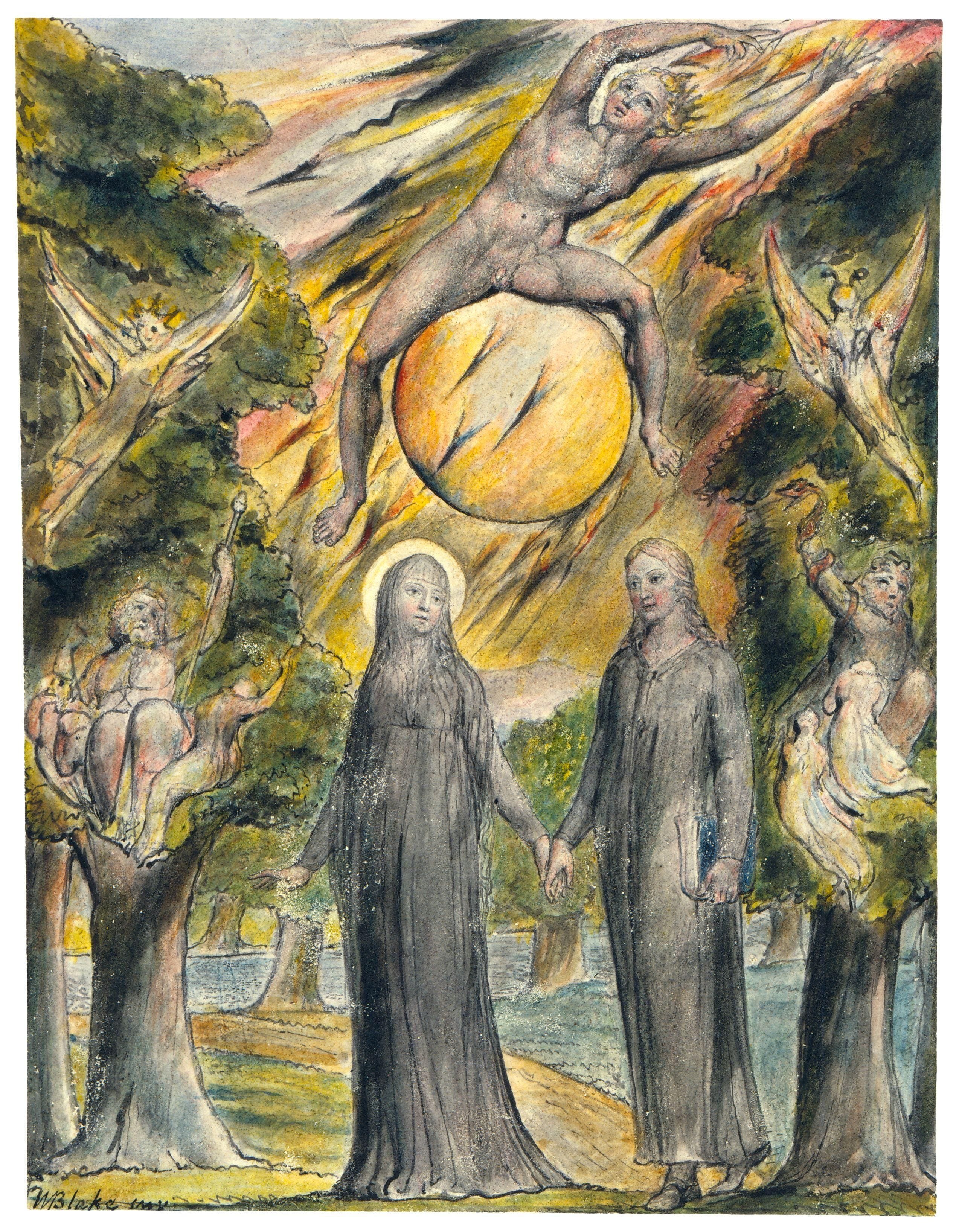
The author also haunts the places where Blake physically lived, although only two of his actual dwelling places still exist at this time - the cottage at Felpham and the flat in South Moulton Street (the first is now being refurbished, and the latter being still part of a disputed appropriation as real estate, instead of a museum.) We also see some of the influences of Blake’s London context - the tenor of the industrial and revolutionary times, as well as the welter of Lambeth with its orphanage, Astley’s wild animal Ampitheatre, and a beached whale in the Thames.
The book itself is properly bound with 456pp, illustrated with both colour plates and black and white images throughout. It also has coloured end papers showing Blake’s Pity and Newton. The chance-come wonder of it also includes no chapter numbers or headings, no footnotes, nor any key to the images, though they are acknowledged at the end, and are referenced in the margins where mentioned in the text. It is book for anyone who loves Blake to read and revel in.
If you are an orderly person who likes things clear and just so, then you need to look elsewhere, but if you are seeped in Blake and want to wade deeper into the amniotic fluid that birthed him and which sent a generative shock-wave through the world of subsequent creatives, then this is probably just the thing.
Philip Hoare: William Blake and the Sea Monsters of Love, 4th Estate, 2025. It is available in hardback, paperback and Kindle.
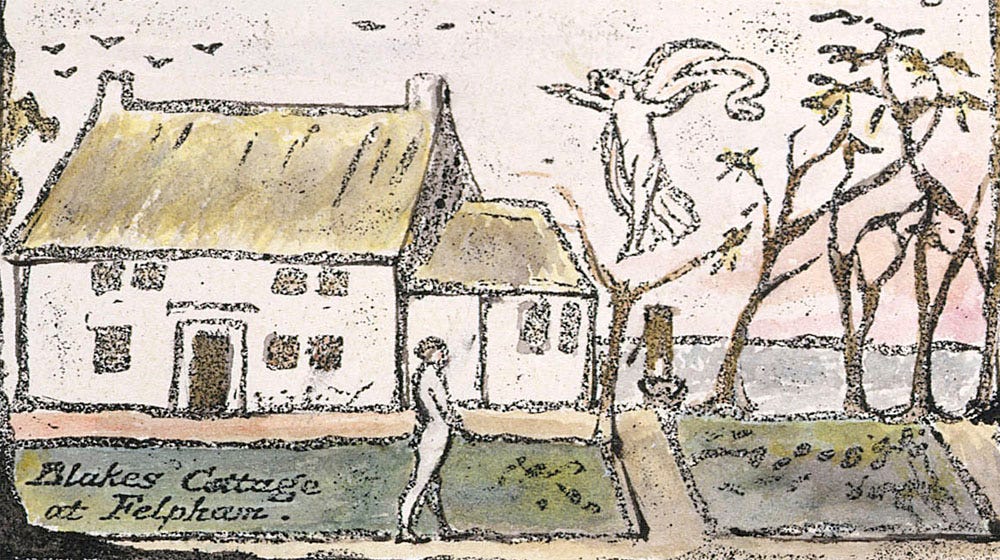
For those who would like to donate to the refurbishment of Blake’s Felpham Cottage in Sussex: you can do so here - it has been saved for the nation as an educational centre, but it still needs a lot of work. You can see the state of the cottage here and donate: https://www.blakecottage.org.
Given the fact that the South Moulton St address is in the hands of the Duke of Westminster, who is more interested in its rental income rather than seeing its potential to become a Blake museum, Felpham may be the only house that can now be saved for those who follow us.
You can also hear a talk about the cottage here:
THE ART OF NATURAL PRAYER COURSE continues to enfold every fortnight here for this who subscribe. This course is written for all people of spirit, to take up their own heritage of prayer beyond denomination, to stand in solidarity with all beings.
Sounds wonderful - I’ve also enjoyed Mark Vernon’s ‘Awake! William Blake and the Power of Imagination’.
Looking forward to this.